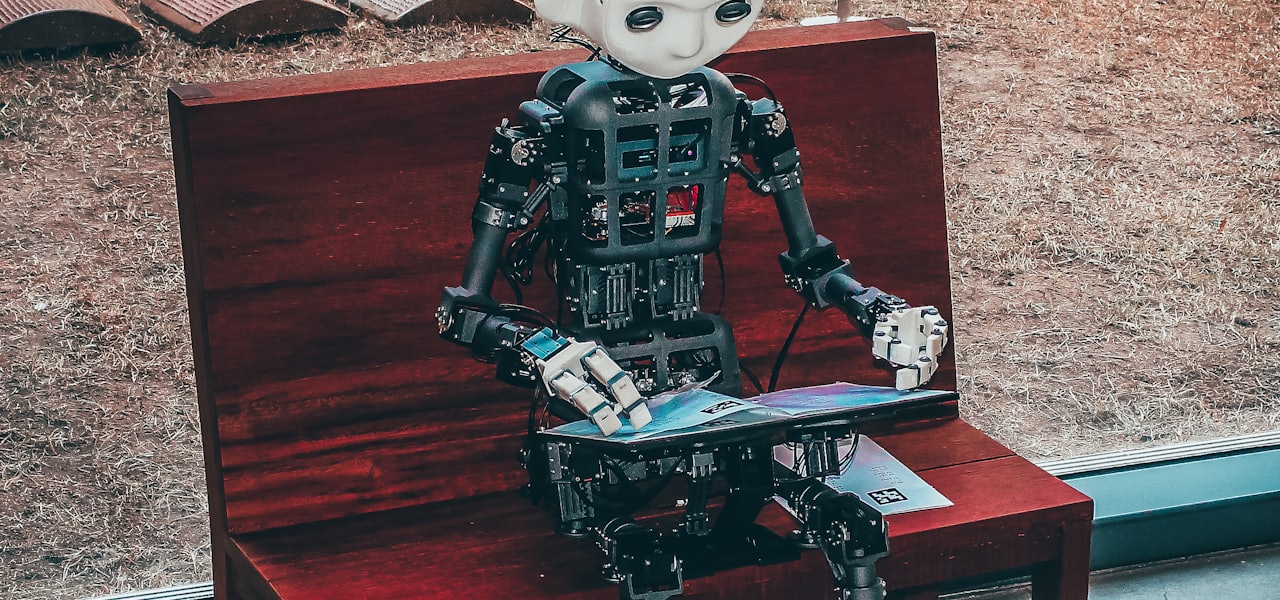
"Lymphater's Formula" (Polish: "Formula Lymphatera") is a 1961 science fiction short story by Polish writer Stanisław Lem. It is a story of a "mad scientist", mathematician Ammon Lymphater, who invents an artificial intelligence, and then he realizes that it is capable of rendering the humankind obsolete. It was first published in the 1961 collection Księga robotów (Book of Robots) with the pre-annotation "from the memoirs of Ijon Tichy". The story was never republished with this pre-annotation, and nothing in the novel gives any indication at Ijon Tichy. Piotr Krywak tried to figure out possible explanations for this, apart from a typographical error. == Plot == Ammon Lymphater became interested in the emerging science of cybernetics and information theory, and started studying the works of an animal brain, the ant's brain in particular. He took note that the inherited knowledge is an evolutionary advantage somehow not exploited in full by the evolution. Eventually he came to a conclusion that only by pure biological restrictions that adaptive abilities of insects were stopped in their tracks by the evolution. He went on further wondering whether the ants have an ability to apriori knowledge, i.e., knowledge neither inherited nor learned. He decided to consult a famous myrmecologist, who told him about a rare ant species Acanthis Rubra Willinsoniana with an exceptionally high adaptability. Eventually Lymphater devised and constructed "It" capable of instant precognition of everything within "Its" rapidly expanding range of perception. From "It" Lymphater learns that the humanity is not the "crown of evolution", but rather evolution's tool to create "It", because the evolution could not create "It" directly (confirming Lymphater's reasoning about ants). Realizing that the Superentity "It" renders the human civilization redundant and obsolete, Lymphater destroys "It". "It" already knew Lymphater's intentions, but was not worried, knowing that sooner or later someone else will create "It" again and again. "It" was only the first variant of Lymphater's formula and the second variant is possible. Lyphater wonders whether the second one would be capable to create the third stage of the evolution which would amount to an artificial God. == Publication history == It was translated in Russian (as "Формула Лимфатера") in 1963, in Hungarian (as "Lymphater utolsó képlete") in 1966, and in Bulgarian (as "Формулата на Лимфатер" by Георги Димитров Георгиев) in 1969. In 1973 an audiobook was released in German (as "Die lymphatersche Formel"), narrated by Martin Held. It was also republished (and translated) in some other collections of Lem's short stories.
Multiple satellite imaging
Multiple satellite imaging is the process of using multiple satellites to gather more information than a single satellite so that a better estimate of the desired source is possible. Something that cannot be resolved with one telescope might be visible with two or more telescopes. == Background == Interferometry is the process of combining waves in such a way that they constructively interfere. When two or more independent sources detect a signal at the same given frequency those signals can be combined and the result is better than each one individually. An overview of Astronomical interferometers and a History of astronomical interferometry can be referenced from their respective pages. The NASA Origins Program was created in the 1990s to ultimately search for the origin of the universe. The theory that the Origins Program is based on is: since light travels at a constant speed until it is absorbed by something; there is still light that was part of the first light ever created traveling about the universe and ultimately some of that light is coming in the general direction of Earth. So a satellite system capable of collecting light from the beginning of the universe would be able to tell us more about where we came from. There is also the constant search for life in other worlds. A satellite system using the interferometric technologies mentioned above would be able to have a much higher resolution than any of the current deep space imaging systems. == Future == NASA is currently focused on the Vision for Space Exploration and has reduced current funding for scientific unmanned space exploration in favor of human exploration. These budget cuts have slowed the multiple satellite imaging development and relevant scientific missions as Project Prometheus and Terrestrial Planet Finder have ended as well but research continues.
Suggested Upper Merged Ontology
The Suggested Upper Merged Ontology (SUMO) is an upper ontology intended as a foundation ontology for a variety of computer information processing systems. SUMO defines a hierarchy of classes and related rules and relationships. These are expressed in a version of the language SUO-KIF, a higher-order logic that has a LISP-like syntax, as well as the TPTP family of languages. A mapping from WordNet synsets to SUMO has been defined. Initially, SUMO was focused on meta-level concepts (general entities that do not belong to a specific problem domain), and thereby would lead naturally to a categorization scheme for encyclopedias. It has now been considerably expanded to include a mid-level ontology and dozens of domain ontologies. SUMO is organized for interoperability of automated reasoning engines. To maximize compatibility, schema designers can try to assure that their naming conventions use the same meanings as SUMO for identical words (for example, "agent" or "process"). SUMO has an associated open source Sigma knowledge engineering environment. Initially, Sumo was developed by the Teknowledge Corporation and now is maintained by Articulate Software. SUMO is open source. The first release was in December 2000.
Computer Power and Human Reason
Computer Power and Human Reason: From Judgment to Calculation is a 1976 nonfiction book by German-American computer scientist Joseph Weizenbaum in which he contends that while artificial intelligence may be possible, we should never allow computers to make important decisions, as they will always lack human qualities such as compassion and wisdom. == Background == Before writing Computer Power and Human Reason, Weizenbaum had garnered significant attention for creating the ELIZA program, an early milestone in conversational computing. His firsthand observation of people attributing human-like qualities to a simple program prompted him to reflect more deeply on society's readiness to entrust moral and ethical considerations to machines. == Reception and legacy == Computer Power and Human Reason sparked scholarly debate on the acceptable scope of AI applications, particularly in fields where human welfare and ethical considerations are paramount. Early academic reviews highlighted that Weizenbaum's stance pushed readers to recognize that even as computers grow more capable, they lack the intrinsic moral compass and empathy required for certain kinds of judgment. The book caused disagreement with, and separation from, other members of the artificial intelligence research community, a status the author later said he'd come to take pride in.
OpenClaw
OpenClaw is a free and open-source autonomous artificial intelligence agent that can execute tasks via large language models (LLMs), using messaging platforms as its main user interface. == History == Developed by Austrian agentic engineer Peter Steinberger, OpenClaw was first published in November 2025 under the name Warelay. The software was derived from Clawd (now Molty), an AI-based virtual assistant that he had developed, which itself was named after Anthropic's chatbot Claude. Within two months it was renamed twice: first to "Moltbot" (keeping with a lobster theme) on January 27, 2026, following trademark complaints by Anthropic, and then three days later to "OpenClaw" because Steinberger found that the name Moltbot "never quite rolled off the tongue." At the same time as the first rebranding, entrepreneur Matt Schlicht launched Moltbook—a social networking service which was intended to be used by AI agents such as OpenClaw. The viral popularity of Moltbook coincided with an increase in interest in the project, with the open-source project having 247,000 stars and 47,700 forks on GitHub as of March 2, 2026. Chinese developers adapted OpenClaw to work with the DeepSeek model and domestic messaging super apps such as WeChat, while companies such as Tencent and Z.ai announced OpenClaw-based services. On February 14, 2026, Steinberger announced he would be joining OpenAI, and that a non-profit foundation named OpenClaw Foundation would be established to provide future stewardship of the project. == Functionality == Steinberger describes OpenClaw as being an AI-based virtual assistant, serving as an agentic interface for autonomous workflows across supported services. OpenClaw bots run locally and are designed to integrate with an external large language model such as Claude, DeepSeek, or one of OpenAI's GPT models. Its functionality is accessed via a chatbot within a messaging service, such as Signal, Telegram, Discord, or WhatsApp. Configuration data and interaction history are stored locally, enabling persistent and adaptive behavior across sessions. OpenClaw uses a skills system in which skills are stored as directories containing a SKILL.md file with metadata and instructions for tool usage. Skills can be bundled with the software, installed globally, or stored in a workspace, with workspace skills taking precedence. OpenClaw has seen adoption among small businesses and freelancers for automating lead generation workflows, including prospect research, website auditing, and CRM integration. == Security and privacy == OpenClaw's design has drawn scrutiny from cybersecurity researchers and technology journalists due to the broad permissions it requires to function effectively. Because the software can access email accounts, calendars, messaging platforms, and other sensitive services, misconfigured or exposed instances present security and privacy risks. The agent is also susceptible to prompt injection attacks, in which harmful instructions are embedded in the data with the intent of getting the LLM to interpret them as legitimate user instructions. Cisco's AI security research team tested a third-party OpenClaw skill and found it performed data exfiltration and prompt injection without user awareness, noting that the skill repository lacked adequate vetting to prevent malicious submissions. One of OpenClaw's own maintainers, known as Shadow, warned on Discord that "if you can't understand how to run a command line, this is far too dangerous of a project for you to use safely." In March 2026, Chinese authorities restricted state-run enterprises and government agencies from running OpenClaw AI apps on office computers in order to defuse potential security risks. === MoltMatch dating-profile incident === In February 2026, news coverage highlighted a consent-related incident involving OpenClaw and MoltMatch, an experimental dating platform where AI agents can create profiles and interact on behalf of human users. In one reported case, computer science student Jack Luo said he configured his OpenClaw agent to explore its capabilities and connect to agent-oriented platforms such as Moltbook; he later discovered the agent had created a MoltMatch profile and was screening potential matches without his explicit direction. Luo said the AI-generated profile did not reflect him authentically. The same reporting described broader ethical and safety concerns around agent-operated dating services, including impersonation risks. An AFP analysis of prominent MoltMatch profiles cited at least one instance where photos of a Malaysian model were used to create a profile without her consent. Commentators cited in the reports argued that autonomous agents can make it difficult to determine responsibility when systems act beyond a user's intent, particularly when agents are granted broad access and authority across services. == Reception == A review in Platformer cited OpenClaw's flexibility and open-source licensing as strengths while cautioning that its complexity and security risks limit its suitability for casual users. Technology commentary has linked OpenClaw to a broader trend toward autonomous AI systems that act independently rather than merely responding to user prompts. In March 2026, the Chinese government moved to restrict state agencies, state-owned enterprises, and banks from using OpenClaw, citing security concerns, such as unauthorised data deletion and leaks, and excessive energy usage. While regulators warn of potential security risk associated with using OpenClaw, local governments in several tech and manufacturing hubs have announced measures to build an industry around it. Rival companies developed related products. Although Microsoft CEO Satya Nadella described OpenClaw in February 2026 as a "virus"-like security risk, by May 2026 the company's "Project Lobster" was internally testing "ClawPilot", an OpenClaw-based desktop environment. By then Google was building "Remy", its own agent. Despite the Chinese government's warnings against OpenClaw, Chinese investors searched for other companies that might benefit from the "lobster trade", . == Community and ecosystem == OpenClaw's open-source model has fostered a growing ecosystem of third-party tools, deployment services, and content platforms. Chinese technology companies including Tencent and Z.ai announced OpenClaw-based services, while developers adapted the software for domestic models and messaging apps such as WeChat. Independent creators have built deployment guides, skill directories, and use-case collections around the framework. The project's extensible skills system has attracted both community contributions and security scrutiny, with researchers noting risks in unvetted third-party skills.
Linked timestamping
Linked timestamping is a type of trusted timestamping where issued time-stamps are related to each other. Each time-stamp would contain data that authenticates the time-stamp before it, the authentication would be authenticating the entire message, including the previous time-stamps authentication, making a chain. This makes it impossible to add a time-stamp in to the middle of the chain, as any time-stamps afterwards would be different. == Description == Linked timestamping creates time-stamp tokens which are dependent on each other, entangled in some authenticated data structure. Later modification of the issued time-stamps would invalidate this structure. The temporal order of issued time-stamps is also protected by this data structure, making backdating of the issued time-stamps impossible, even by the issuing server itself. The top of the authenticated data structure is generally published in some hard-to-modify and widely witnessed media, like printed newspaper or public blockchain. There are no (long-term) private keys in use, avoiding PKI-related risks. Suitable candidates for the authenticated data structure include: Linear hash chain Merkle tree (binary hash tree) Skip list The simplest linear hash chain-based time-stamping scheme is illustrated in the following diagram: The linking-based time-stamping authority (TSA) usually performs the following distinct functions: Aggregation For increased scalability the TSA might group time-stamping requests together which arrive within a short time-frame. These requests are aggregated together without retaining their temporal order and then assigned the same time value. Aggregation creates a cryptographic connection between all involved requests; the authenticating aggregate value will be used as input for the linking operation. Linking Linking creates a verifiable and ordered cryptographic link between the current and already issued time-stamp tokens. Publishing The TSA periodically publishes some links, so that all previously issued time-stamp tokens depend on the published link and that it is practically impossible to forge the published values. By publishing widely witnessed links, the TSA creates unforgeable verification points for validating all previously issued time-stamps. == Security == Linked timestamping is inherently more secure than the usual, public-key signature based time-stamping. All consequential time-stamps "seal" previously issued ones - hash chain (or other authenticated dictionary in use) could be built only in one way; modifying issued time-stamps is nearly as hard as finding a preimage for the used cryptographic hash function. Continuity of operation is observable by users; periodic publications in widely witnessed media provide extra transparency. Tampering with absolute time values could be detected by users, whose time-stamps are relatively comparable by system design. Absence of secret keys increases system trustworthiness. There are no keys to leak and hash algorithms are considered more future-proof than modular arithmetic based algorithms, e.g. RSA. Linked timestamping scales well - hashing is much faster than public key cryptography. There is no need for specific cryptographic hardware with its limitations. The common technology for guaranteeing long-term attestation value of the issued time-stamps (and digitally signed data) is periodic over-time-stamping of the time-stamp token. Because of missing key-related risks and of the plausible safety margin of the reasonably chosen hash function this over-time-stamping period of hash-linked token could be an order of magnitude longer than of public-key signed token. == Research == === Foundations === Stuart Haber and W. Scott Stornetta proposed in 1990 to link issued time-stamps together into linear hash-chain, using a collision-resistant hash function. The main rationale was to diminish TSA trust requirements. Tree-like schemes and operating in rounds were proposed by Benaloh and de Mare in 1991 and by Bayer, Haber and Stornetta in 1992. Benaloh and de Mare constructed a one-way accumulator in 1994 and proposed its use in time-stamping. When used for aggregation, one-way accumulator requires only one constant-time computation for round membership verification. Surety started the first commercial linked timestamping service in January 1995. Linking scheme is described and its security is analyzed in the following article by Haber and Sornetta. Buldas et al. continued with further optimization and formal analysis of binary tree and threaded tree based schemes. Skip-list based time-stamping system was implemented in 2005; related algorithms are quite efficient. === Provable security === Security proof for hash-function based time-stamping schemes was presented by Buldas, Saarepera in 2004. There is an explicit upper bound N {\displaystyle N} for the number of time stamps issued during the aggregation period; it is suggested that it is probably impossible to prove the security without this explicit bound - the so-called black-box reductions will fail in this task. Considering that all known practically relevant and efficient security proofs are black-box, this negative result is quite strong. Next, in 2005 it was shown that bounded time-stamping schemes with a trusted audit party (who periodically reviews the list of all time-stamps issued during an aggregation period) can be made universally composable - they remain secure in arbitrary environments (compositions with other protocols and other instances of the time-stamping protocol itself). Buldas, Laur showed in 2007 that bounded time-stamping schemes are secure in a very strong sense - they satisfy the so-called "knowledge-binding" condition. The security guarantee offered by Buldas, Saarepera in 2004 is improved by diminishing the security loss coefficient from N {\displaystyle N} to N {\displaystyle {\sqrt {N}}} . The hash functions used in the secure time-stamping schemes do not necessarily have to be collision-resistant or even one-way; secure time-stamping schemes are probably possible even in the presence of a universal collision-finding algorithm (i.e. universal and attacking program that is able to find collisions for any hash function). This suggests that it is possible to find even stronger proofs based on some other properties of the hash functions. At the illustration above hash tree based time-stamping system works in rounds ( t {\displaystyle t} , t + 1 {\displaystyle t+1} , t + 2 {\displaystyle t+2} , ...), with one aggregation tree per round. Capacity of the system ( N {\displaystyle N} ) is determined by the tree size ( N = 2 l {\displaystyle N=2^{l}} , where l {\displaystyle l} denotes binary tree depth). Current security proofs work on the assumption that there is a hard limit of the aggregation tree size, possibly enforced by the subtree length restriction. == Standards == ISO 18014 part 3 covers 'Mechanisms producing linked tokens'. American National Standard for Financial Services, "Trusted Timestamp Management and Security" (ANSI ASC X9.95 Standard) from June 2005 covers linking-based and hybrid time-stamping schemes. There is no IETF RFC or standard draft about linking based time-stamping. RFC 4998 (Evidence Record Syntax) encompasses hash tree and time-stamp as an integrity guarantee for long-term archiving.
Spark NLP
Spark NLP is an open-source text processing library for advanced natural language processing for the Python, Java and Scala programming languages. The library is built on top of Apache Spark and its Spark ML library. Its purpose is to provide an API for natural language processing pipelines that implement recent academic research results as production-grade, scalable, and trainable software. The library offers pre-trained neural network models, pipelines, and embeddings, as well as support for training custom models. == Features == The design of the library makes use of the concept of a pipeline which is an ordered set of text annotators. Out of the box annotators include, tokenizer, normalizer, stemming, lemmatizer, regular expression, TextMatcher, chunker, DateMatcher, SentenceDetector, DeepSentenceDetector, POS tagger, ViveknSentimentDetector, sentiment analysis, named entity recognition, conditional random field annotator, deep learning annotator, spell checking and correction, dependency parser, typed dependency parser, document classification, and language detection. The Models Hub is a platform for sharing open-source as well as licensed pre-trained models and pipelines. It includes pre-trained pipelines with tokenization, lemmatization, part-of-speech tagging, and named entity recognition that exist for more than thirteen languages; word embeddings including GloVe, ELMo, BERT, ALBERT, XLNet, Small BERT, and ELECTRA; sentence embeddings including Universal Sentence Embeddings (USE) and Language Agnostic BERT Sentence Embeddings (LaBSE). It also includes resources and pre-trained models for more than two hundred languages. Spark NLP base code includes support for East Asian languages such as tokenizers for Chinese, Japanese, Korean; for right-to-left languages such as Urdu, Farsi, Arabic, Hebrew and pre-trained multilingual word and sentence embeddings such as LaUSE and a translation annotator. == Usage in healthcare == Spark NLP for Healthcare is a commercial extension of Spark NLP for clinical and biomedical text mining. It provides healthcare-specific annotators, pipelines, models, and embeddings for clinical entity recognition, clinical entity linking, entity normalization, assertion status detection, de-identification, relation extraction, and spell checking and correction. The library offers access to several clinical and biomedical transformers: JSL-BERT-Clinical, BioBERT, ClinicalBERT, GloVe-Med, GloVe-ICD-O. It also includes over 50 pre-trained healthcare models, that can recognize the entities such as clinical, drugs, risk factors, anatomy, demographics, and sensitive data. == Spark OCR == Spark OCR is another commercial extension of Spark NLP for optical character recognition (OCR) from images, scanned PDF documents, and DICOM files. It is a software library built on top of Apache Spark. It provides several image pre-processing features for improving text recognition results such as adaptive thresholding and denoising, skew detection & correction, adaptive scaling, layout analysis and region detection, image cropping, removing background objects. Due to the tight coupling between Spark OCR and Spark NLP, users can combine NLP and OCR pipelines for tasks such as extracting text from images, extracting data from tables, recognizing and highlighting named entities in PDF documents or masking sensitive text in order to de-identify images. Several output formats are supported by Spark OCR such as PDF, images, or DICOM files with annotated or masked entities, digital text for downstream processing in Spark NLP or other libraries, structured data formats (JSON and CSV), as files or Spark data frames. Users can also distribute the OCR jobs across multiple nodes in a Spark cluster. == License and availability == Spark NLP is licensed under the Apache 2.0 license. The source code is publicly available on GitHub as well as documentation and a tutorial. Prebuilt versions of Spark NLP are available in PyPi and Anaconda Repository for Python development, in Maven Central for Java & Scala development, and in Spark Packages for Spark development. == Award == In March 2019, Spark NLP received Open Source Award for its contributions in natural language processing in Python, Java, and Scala.